Scaling Human Lifespan: The Systems Architecture of Biological Longevity
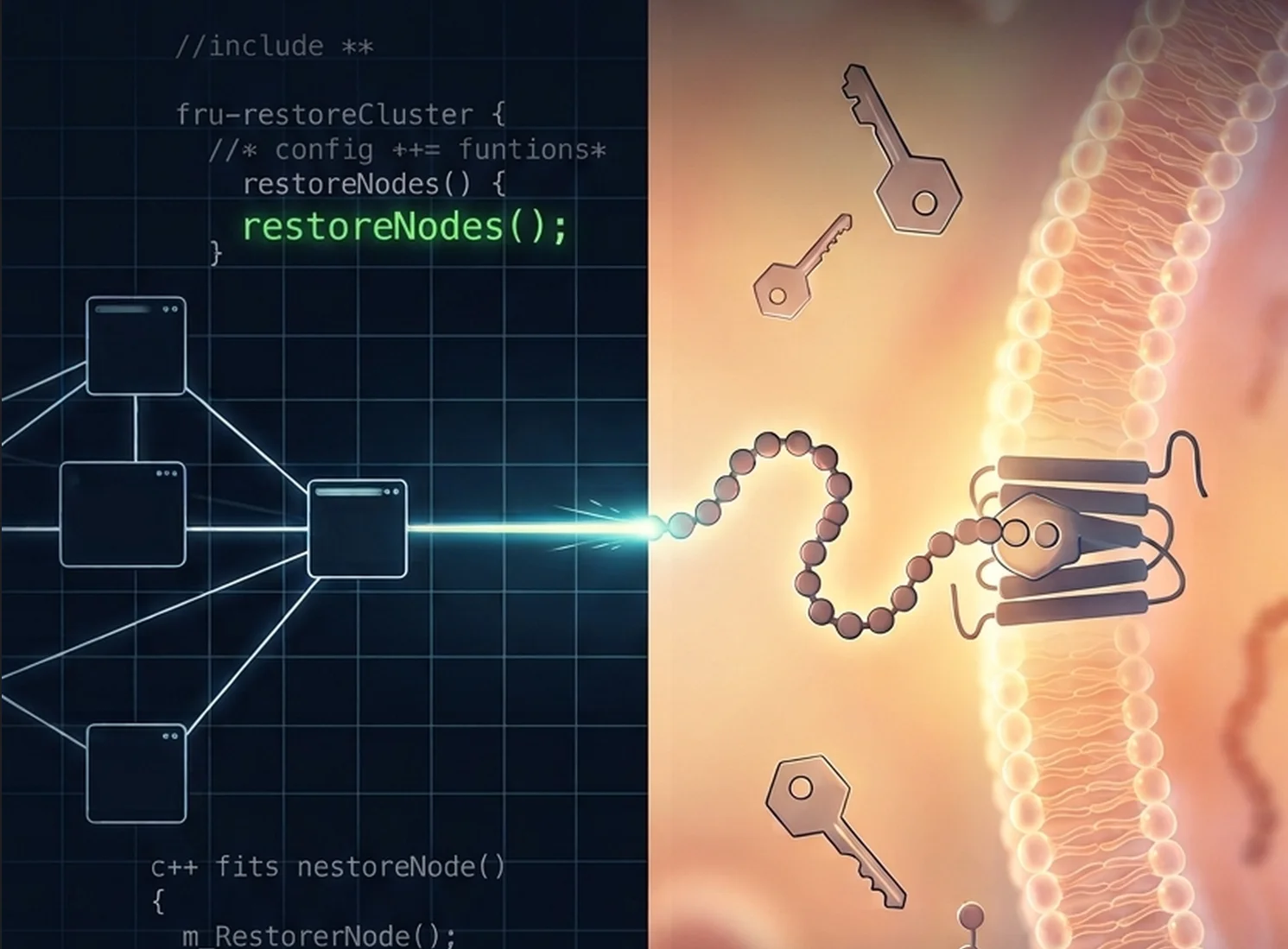
In systems engineering, we define a “leak” as the gradual depletion of resources due to inefficient reclamation. In biological systems, we call this aging. To scale the human lifespan beyond its current ~120-year local maximum, we must move beyond the “patching” mentality of modern medicine and enter the era of Systems Orchestration.
Medicine, as practiced today, is a discipline of hotfixes. We wait for a subsystem to throw an exception—a tumor, an infarction, an organ failure—and then we patch it in production, under load, with the patient's life as the staging environment. It is heroic, and it is also architecturally backwards. No serious engineer would run a global-scale system this way: blind to telemetry, reactive to outages, with no model of the resource leaks silently accumulating beneath the surface. Yet this is exactly how we run the human body. The thesis of this article is simple: aging is not a mystery, it is an engineering problem—and engineering problems yield to observability, redundancy, and formal verification.
Reactive medicine treats symptoms as they surface—downstream failures of an unmonitored system. Effective, but fundamentally a losing race against entropy.
Proactive longevity engineering models the whole organism as a system—detecting resource leaks and identity drift before they manifest as disease.
Standing on the Shoulders of Existing Science
Before going further, a critical clarification. The systems-engineering lens offered here is not a replacement for biology—it is a complement to decades of rigorous, hard-won scientific work. The molecular network that makes aging tractable has already been mapped, named, and formalized by disciplines far older and deeper than software. Our contribution is not the biology; it is the simulation infrastructure, observability tooling, and compute orchestration that let these disciplines operate at a scale their insights deserve.
Chief among these is Network Medicine—pioneered by Albert-László Barabási and Joseph Loscalzo—which reframed disease as a perturbation of the interactome, the complete network of molecular interactions within a cell. Its concepts map almost one-to-one onto the vocabulary of distributed systems, which is precisely why the engineering analogy holds.
Network Medicine — the Interactome as System Topology
The interactome is a literal network topology of the organism. “Disease modules”—neighborhoods where disease genes cluster—are the biological equivalent of failure domains, and comorbidity networks describe exactly how faults cascade across coupled subsystems. This is the scientific bedrock beneath every “liveness violation” metaphor in this article.
Systems Biology — the Organism as a Dynamic System
Long before “orchestration” entered our vocabulary, systems biology modeled cells as networks of feedback loops and emergent behavior rather than isolated parts. Its dynamical models are the equations our simulations solve at scale.
Geroscience & the Hallmarks of Aging
Geroscience advances the unifying hypothesis that targeting aging itself prevents many diseases at once, decomposing the process into the well-known hallmarks of aging—a list of independently addressable failure modes. That decomposition is what makes the problem engineerable in the first place.
Systems / P4 Medicine — Proactive by Design
Leroy Hood's vision of Predictive, Preventive, Personalized, and Participatory medicine already argued for a data-dense, proactive practice. Our “observability before failure” principle is an engineering restatement of a goal these fields set long ago.
The point is this: the science is not the bottleneck, and it is not ours to claim. The interactome has been mapped; the hallmarks have been enumerated; the therapeutic targets are known. What has lagged is the infrastructure to simulate these networks at petascale, stream their telemetry in real time, and iterate on interventions faster than a wet lab ever could. That is the gap a systems engineer can fill—in service of Network Medicine, systems biology, and geroscience, never in place of them.
Cellular Orchestration: Resolving the “Epigenetic Leak”
The Information Theory of Aging, popularized by Dr. David Sinclair, posits that aging is a loss of digital-to-analog information. Cells lose their identity because the epigenome—the “software” that tells a skin cell it is a skin cell—becomes corrupted by noise. Every DNA repair, every inflammatory event, every division introduces a small amount of drift. Over decades, the signal-to-noise ratio degrades until the cell can no longer reliably read its own instructions.
“Aging is simply the accumulation of lost epigenetic information, leading to cellular identity drift. If we can reboot the software, we can restore the hardware.”— Dr. David Sinclair, Harvard Medical School
Scaling longevity requires the deployment of Epigenetic Resets. By utilizing partial cellular reprogramming (Yamanaka factors), we can theoretically revert cells to a younger state without stripping them of their differentiated identity. This is the biological equivalent of a “System Restore” to a known stable point—rolling back the corrupted configuration while preserving the data. The critical constraint is the same one every backup engineer knows intimately: you must restore to a checkpoint that is younger than the corruption but not so early that the cell forgets what it is supposed to be. Too little reset, and the leak persists; too much, and the cell de-differentiates into a liability.
The Epigenome as Configuration
The genome is read-only firmware; the epigenome is the mutable configuration layer that decides which genes are active. Aging is configuration drift—the slow corruption of that layer. Reprogramming is the process of re-flashing a known-good configuration without touching the underlying firmware.
Reclamation & Garbage Collection
Autophagy is the cell's garbage collector. When it stalls, misfolded proteins and dysfunctional organelles accumulate—unreclaimed resources leaking into the working set. Restoring efficient reclamation (senolytics for zombie cells, autophagy induction for aggregates) is longevity's answer to a memory leak.
Observability Before Failure
You cannot orchestrate what you cannot measure. Aging clocks—methylation-based biomarkers of biological age—are the first real telemetry for the organism. They turn “how old are you?” from a calendar question into a measurable, addressable system metric.
The Bio-Compute Layer: AI and Computational Biology
The hardware and cellular software optimizations described above are only possible through the lens of Computational Biology and massive compute pipelines. Tools like DeepMind's AlphaFold have already demonstrated the power of this approach by effectively solving the 50-year-old “protein folding problem”—a breakthrough that was fundamentally limited by compute availability before the current era of hyperscale AI infrastructure.
This is the crucial insight for systems engineers, and it is where our contribution lives: the bottleneck to longevity is increasingly not biological knowledge—it is infrastructure. The structural dynamics of ~20,000 human proteins represent a high-dimensional telemetry problem that requires petascale GPU orchestration and specialized inference kernels. The pipes that let researchers in Network Medicine and systems biology simulate millions of metabolic pathways in parallel—identifying cellular “liveness violations” before they manifest as disease—are the same distributed-systems primitives we already know how to build: schedulers, message queues, fault-tolerant storage, and inference at scale. We do not discover the biology; we build the instruments that let those who do move faster.
Model folding, binding, and metabolic dynamics across millions of candidate states in parallel.
Stream high-dimensional biological telemetry—aging clocks, proteomics, pathway activity.
Flag liveness violations—leaks and identity drift—before they cascade into clinical failure.
Design and validate targeted therapeutics—reprogramming factors, senolytics, engineered peptides.
This is precisely where advanced research agents enter the picture. Purpose-built systems that design, fold, and validate longevity peptides against these targets turn the compute layer into a discovery engine—compressing what were once multi-year experimental cycles into iterative, in-silico loops. We explore one such system in depth in our companion article, Beltroni's Nikola Research AI Agent for longevity peptide design.
A Call to Systems Engineers: Do Not Give Up
To the systems engineers reading this: the biological substrate is just another complex system. While the scale of the human genome and the complexity of metabolic pathways may seem daunting, they are not insurmountable. The same principles of observability, redundancy, and formal verification that we apply to global-scale datacenters are the keys to unlocking the next century of human life.
We spend careers guaranteeing five-nines uptime for services that shuttle bytes. Imagine redirecting that discipline toward the one system whose uptime actually matters. The failure modes are familiar: unmonitored leaks, corrupted configuration, stalled garbage collection, cascading faults. The tools are here, the data is accumulating, and the infrastructure is finally catching up.
And to be clear about the assignment: our role is not to out-biology the biologists. The researchers of Network Medicine, systems biology, and geroscience have already done—and continue to do—the profound scientific work. Our mission is to hand them better instruments: faster simulations, deeper observability, and orchestration that turns their models into iterative, testable experiments at a scale no wet lab alone can reach. It is a complementary contribution, and a decisive one.
We must not give up on the path toward scaling the human lifespan. It is a collective human mission to move from accidental biological survival to engineered longevity. The problem is hard, but so was protein folding—until it wasn't.
From Thesis to Infrastructure
The orchestration layer described here is already being built. See how our Nikola Research AI Agent applies this systems approach to real longevity peptide design, folding, and validation.
Read: Nikola Longevity Research AI →